DELII: Thinking Differently About Immunotherapy, Access, and What Really Matters
Section - Journal Watch

Immunotherapy has revolutionized oncology but remains prohibitively expensive. Most oncology trials are conducted at the highest safe dose to maximize drug efficacy. But what if a substantially lower dose could achieve similar clinical benefit, with fewer side effects to boot?
Once a drug is approved, such dose de-escalation is rarely pursued by pharmaceutical companies. Recently, Tata Memorial published a large randomized controlled superiority trial name DELII, evaluating immunotherapy at just 10% of the standard dose (AND COST), demonstrating that it remains effective.
While the trial itself is excellent, its implications extend far beyond the obvious. In this insightful piece, the lead investigators dissect the broader impact of the findings.
- Editorial board
Immune checkpoint inhibitors have changed oncology in ways that would have been difficult to imagine fifteen years ago. For a subset of patients, they have delivered durable responses, long-term survival, and in rare cases, something that begins to resemble cure. Yet alongside this success runs a quieter, more uncomfortable truth: for most patients across the world, immunotherapy remains aspirational rather than attainable.
The Development of Low-Dose Immunotherapy in India (DELII) study emerged from this tension: between what is scientifically possible and what is practically deliverable.
The question that led to DELII was not born in a laboratory or a boardroom. It arose in the general clinics at Tata Memorial Hospital, where innumerable conversations with our patients and families about treatment options were inevitably shaped by cost, logistics, and the limits of public funding. While pharmacokinetic and pharmacodynamic studies had long shown that PD-1 receptor occupancy plateaus at doses far lower than those eventually approved, clinical practice continued to rely on fixed, high doses that were never meaningfully revisited once regulatory acceptance was achieved. In settings where even generic chemotherapy strains patients and institutions, this disconnect becomes impossible to ignore.
The Study
DELII was designed to test a simple but unsettling idea: could ultra-low-dose Nivolumab (at 10% dose) retain meaningful clinical efficacy when compared with standard chemotherapy in patients with relapsed or refractory solid tumours? The study randomized patients to receive Nivolumab at 20 mg every two weeks or physician’s choice chemotherapy. The population was heavily pretreated, dominated by head and neck and lung cancers, and reflective of the patients typically seen in large public cancer centres.
The results were, in many ways, exactly what one might expect from immunotherapy in this setting, and yet still surprising. Ultra-low-dose Nivolumab led to a statistically significant improvement in overall survival, with a hazard ratio of 0.80 and a clear separation of curves beyond the early months. One-year survival was meaningfully higher from ultra-low-dose immunotherapy as compared to physician’s choice chemotherapy. Progression-free survival did not differ, a pattern familiar to anyone who has followed immunotherapy trials over the last decade. Toxicity was lower, hospitalizations were fewer, and quality of life trajectories consistently favoured immunotherapy.
It is tempting to focus narrowly on the absolute gain in median survival, which was just over a month, and to ask whether this is enough. But that question cannot be asked in isolation. In relapsed disease, particularly after one or more prior lines of therapy, gains of this magnitude have often been considered clinically worthwhile, especially when accompanied by better tolerability and an improvement in the quality of life.
What makes DELII different is not the size of the benefit alone, but the context in which it is achieved and the implications that follow.
The implications
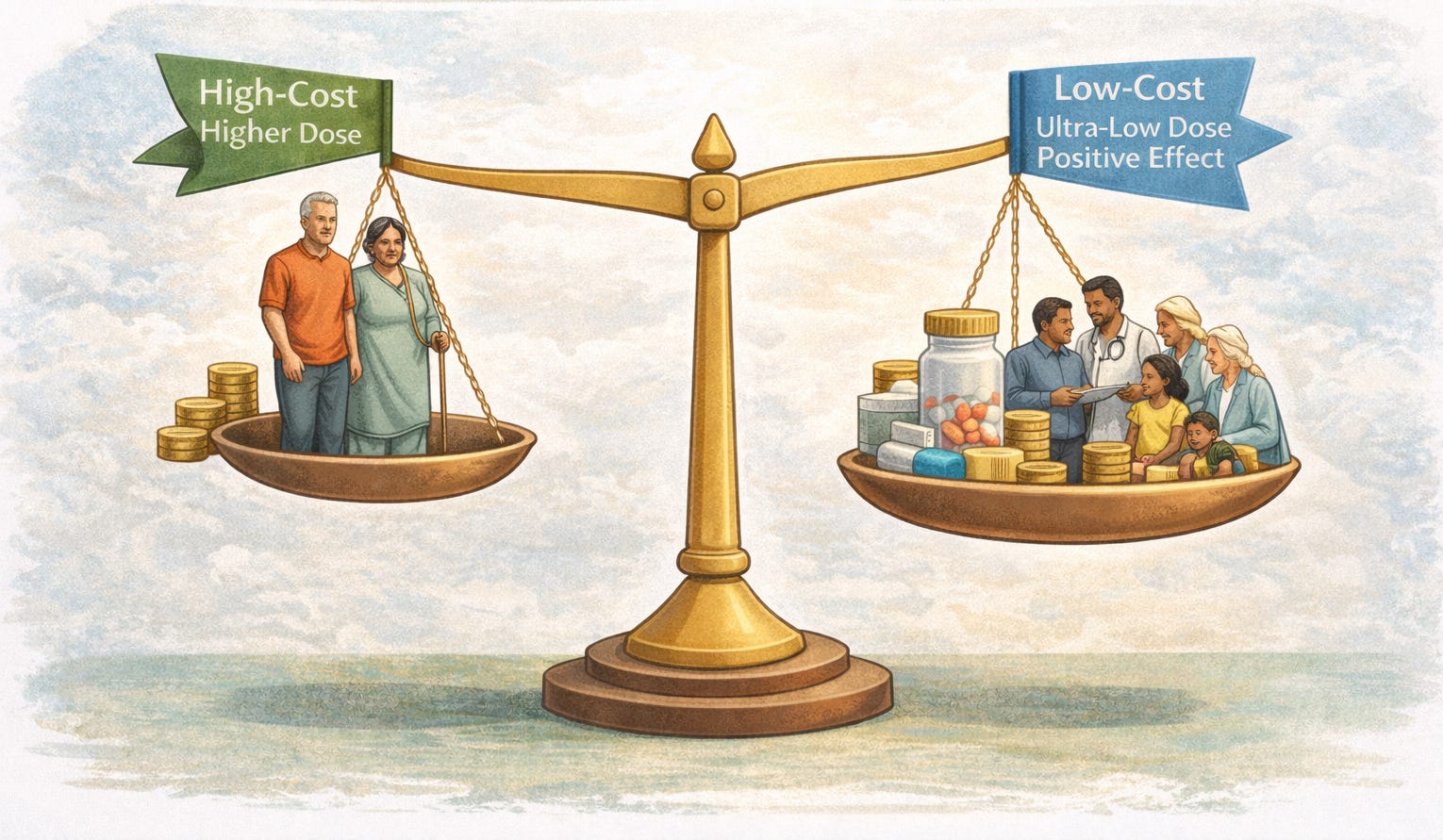
In many government hospitals, immunotherapy is not truly “available” in any practical sense. It may exist on paper, or for a very small subset of patients who meet stringent criteria or secure exceptional funding. For the majority, it remains out of reach. An ultra-low-dose approach changes this dynamic entirely. By dramatically reducing drug consumption, the same budget can treat several times more patients. For a publicly funded institution working within fixed and often inflexible resource envelopes, this matters enormously.
The implications extend beyond individual hospitals. Public insurance schemes and state-funded cancer programs are constantly balancing competing priorities. Every high-cost intervention forces a choice: depth of benefit for a few versus some benefit for many. DELII suggests that this does not always have to be a zero-sum decision. A biologically rational, lower-dose strategy offers the possibility of widening access without proportionately increasing expenditure. In systems where sustainability is as important as innovation, that is not a trivial consideration.
Philanthropy plays a parallel role in many LMIC settings, often stepping in where public funding falls short. Yet philanthropic resources are finite and must be used judiciously. When a single patient’s treatment consumes the bulk of a donation, the emotional impact may be high, but the population-level effect is limited. Low-dose immunotherapy allows the same generosity to reach more patients, turning isolated acts of support into something closer to a public health intervention. In this sense, DELII sits at the intersection of science and social responsibility.
There is also a broader message here about where meaningful oncology research can and should come from. Too often, studies from developing countries are viewed as confirmatory or descriptive, rather than hypothesis-generating. DELII challenges that notion. It addresses a question that is globally relevant but locally urgent, using a randomised design, hard endpoints, and careful follow-up. It demonstrates that research grounded in the realities of LMIC practice can still speak to the wider oncology community.
The conduct of the study also reflects the value of collaboration across disease management groups. By enrolling patients with multiple tumour types, DELII mirrors real-world practice more closely than many disease-specific trials. In large public hospitals, care is inherently multidisciplinary, and rigid silos rarely serve patients well. The consistency of benefit across subgroups in DELII, while not definitive for any single tumour type, strengthens confidence in the overarching concept.
Of course, the study has limitations, and these deserve open acknowledgment. DELII was conceived at a time when immunotherapy was used later in the disease course; by the time the data matured, standards of care had shifted, particularly in lung and head and neck cancers. The trial was conducted at a single centre, raising questions about generalizability, especially to settings with different patient profiles or supportive care structures. It was not powered to detect tumour-specific effects, and its findings should not be overextended beyond the population studied.
Yet these limitations do not negate the central insight. Rather, they define the next set of questions. Can low-dose strategies be validated across centres? Are there biomarkers that might help identify patients most likely to benefit at lower doses? Could similar principles apply earlier in the disease course or in combination regimens? DELII does not answer all of these questions, but it makes them reasonable to ask.
Perhaps most importantly, the study invites a reconsideration of how we think about dose, value, and sufficiency in oncology. The history of cancer therapeutics has been shaped by a “more is better” philosophy, inherited largely from cytotoxic chemotherapy. Immunotherapy does not always conform to that logic. DELII suggests that in certain contexts, doing less, thoughtfully and deliberately, may achieve outcomes that are good enough to matter, especially when measured against the realities of access and equity.
In the end, DELII is not a statement about replacing standard-dose immunotherapy everywhere. It is a reminder that oncology does not exist in a vacuum. Treatments must work not only in trials, but in health systems as they actually function. For patients in resource-constrained settings, and for the clinicians who care for them, that distinction is not theoretical. It is lived every day.
- Dr Kumar Prabhash, Director, Homi Bhabha Cancer Hospital and Research Centre, TMC Muzaffarpur
Dr Vanita Noronha, Professor, Dept of Medical Oncology, Tata Memorial Hospital